


Latest Update: Monday 24th May 2004
Travel History:
U.K. (The beginning) : 26 June 2002
France : 27 June - 5 July 2002
Portugal : 20 July - 23 July 2002
Morocco & Gibraltar : 24 July - 9 August 2002
Spain (again) : 10 August - 18 September 2002
Italy : 19 September - 4 October 2002
Greece : 5 October - 11 October 2002
Turkey : 12 October - 24 October 2002
Syria : 25 October - 3 November 2002
Jordan : 4 November - 14 November 2002
Egypt : 15 November - 11 December 2002
Jordan & Syria (again) : 12 December - 16 December 2002
Turkey (again) : 17 December 2002 - 31 January 2003
Delhi : 1 February - 2 February 2003
Rajasthan : 3 February - 15 February 2003
Bombay (Mumbai) :
17 February 2003
Goa :
18 February - 5 March 2003
Karnataka :
6 March - 16 March 2003
Tamil Nadu :
17 March - 24 March 2003
Kerala :
25 March - 9 April 2003
Delhi :
10 April - 13 April 2003
Himachal Pradesh :
14 April - 19 April 2003
Uttaranchal & Delhi :
20 April - 4 May 2003
Sikkim & West Bengal :
5 May - 24 May 2003
Tibet : 19 July - 31 July 2003
Nepal (again) : 1 August - 8 August 2003
Uttar Pradesh & Delhi :
9 August - 10 August 2003
Punjab & Haryana :
11 August - 13 August 2003
Himachal Pradesh :
14 August - 19 August 2003
Jammu & Kashmir
(Ladakh) : 20 August - 12 September 2003
Uttar Pradesh : 13 September - 16 September 2003
Calcutta (Kolkata) : 17 September - 23 September 2003
Andaman &
Nicobar Islands :
24 September - 17 October 2003
Calcutta (Kolkata) :
18 October - 23 October 2003
Thailand : 24 October - 12 November 2003
Laos : 13 November - 2 December 2003
Vietnam : 3 December - 23 December 2003
Cambodia : 24 December 2003 - 4 January 2004
Thailand (again) : 5 January - 1 February 2004
Malaysia : 2 February - 20 February 2004
Singapore : 21 February - 24 February 2004
Malaysia (again) : 25 February -26 February 2004
Indonesia : 27 February - 9 March 2004
Malaysia & Singapore (again) : 10 March - 13 March 2004
Australia : 14 March - 29 March 2004
New Zealand : 30 March - 20 May 2004
Malaysia : 21 May - 23 May 2004
Nepal : 24 May -
We set off on the morning of Wednesday 26 June 2002 in our little Fiat Uno and drove down from Lancaster, stopping off for the night with some friends near Brighton - Cheers Steve and Carole, and sorry that we were so tired and not terribly good company that night. It was great seeing everyone before we left but by the time we had said goodbye to you all we were both emotional drained and physically exhausted. The following morning we drove via Canterbury (for lunch with Jennie) and on to Dover in time to catch the late afternoon ferry to Calais.


Friday 12th July 2002 update - Bilbao, Spain.

 From
there we headed south from and camped at a beautiful spot just outside of Chartres, a fascinating medieval cathedral town and within easy reach
of Paris. So we took the train into Paris on the following day - using my
primary school level French to ask for the tickets, only to be replied to in
perfect English.
From
there we headed south from and camped at a beautiful spot just outside of Chartres, a fascinating medieval cathedral town and within easy reach
of Paris. So we took the train into Paris on the following day - using my
primary school level French to ask for the tickets, only to be replied to in
perfect English.

 We
then headed for the coast and
found a campsite right next to Mont S. Michel, which was stunningly impressive, if a bit too touristy (and
where it was pissing with rain), so we didn't hang about too long before heading south again
through Bordeaux, and stopping off in the Loire valley to visit the odd chateau.
The car has been causing us a few problems these past few days - it looks like
the handbrake cable has snapped (we're now carrying a small rock as a
substitute) and the exhaust has started blowing like a tractor. So far
we've been unable to find a garage that'll fix it so we're hoping that it'll
last out until we get to Bilbao, where some friends of ours may be able to help
us out. By now the rain was really beginning to get us down so we decided to push on
further south, over the Pyrenees
and into Spain.
We
then headed for the coast and
found a campsite right next to Mont S. Michel, which was stunningly impressive, if a bit too touristy (and
where it was pissing with rain), so we didn't hang about too long before heading south again
through Bordeaux, and stopping off in the Loire valley to visit the odd chateau.
The car has been causing us a few problems these past few days - it looks like
the handbrake cable has snapped (we're now carrying a small rock as a
substitute) and the exhaust has started blowing like a tractor. So far
we've been unable to find a garage that'll fix it so we're hoping that it'll
last out until we get to Bilbao, where some friends of ours may be able to help
us out. By now the rain was really beginning to get us down so we decided to push on
further south, over the Pyrenees
and into Spain.

 As
soon as we got over the border and started our descent through the mountains the
rain stopped and the sun broke through the clouds making us feel much better.
We stopped first at a small campsite near Lumbier in Nevarra, where we spent a
good few days walking in the hills, sampling the local wine and exploring some
of the small towns and villages in the neighbourhood, and by chance came across
a small Franciscan monastery where St. Francis Xavier once lived and whom we
expected to meet again later on in our travels, probably looking rather
the worse for wear, in a Cathedral in India.
As
soon as we got over the border and started our descent through the mountains the
rain stopped and the sun broke through the clouds making us feel much better.
We stopped first at a small campsite near Lumbier in Nevarra, where we spent a
good few days walking in the hills, sampling the local wine and exploring some
of the small towns and villages in the neighbourhood, and by chance came across
a small Franciscan monastery where St. Francis Xavier once lived and whom we
expected to meet again later on in our travels, probably looking rather
the worse for wear, in a Cathedral in India.

 From
here we headed west into the Basque country to pay a visit on Begoña
& Jorge who live in Bilbao. It's lovely here, very green and hilly (not what you expect in Spain),
and we're having a really nice time being pampered by Begoña
& Jorge and their flatmates who have made us feel like part of their family.
Staying here we have been able to see a
side to Spanish culture that we wouldn't have been able to otherwise, and
everyone has been so friendly and taken time out to show us around.
From
here we headed west into the Basque country to pay a visit on Begoña
& Jorge who live in Bilbao. It's lovely here, very green and hilly (not what you expect in Spain),
and we're having a really nice time being pampered by Begoña
& Jorge and their flatmates who have made us feel like part of their family.
Staying here we have been able to see a
side to Spanish culture that we wouldn't have been able to otherwise, and
everyone has been so friendly and taken time out to show us around.

 Since
we've been here we've visited the Guggenheim museum (which we found to be
impressive, amusing and just plain silly in turns), and
gone off in Begoña's little car exploring the
countryside which reminds us of the limestone Yorkshire dales in places.
We've also enjoyed sampling the local food, especially the tapas and pixcos which are
small nibbles (mushrooms, olives, fish etc) which are usually served to you
when you order a beer in a bar - Potatas Bravas (fried Potatoes in a red chilly
source) are a particular favourite with us.
Since
we've been here we've visited the Guggenheim museum (which we found to be
impressive, amusing and just plain silly in turns), and
gone off in Begoña's little car exploring the
countryside which reminds us of the limestone Yorkshire dales in places.
We've also enjoyed sampling the local food, especially the tapas and pixcos which are
small nibbles (mushrooms, olives, fish etc) which are usually served to you
when you order a beer in a bar - Potatas Bravas (fried Potatoes in a red chilly
source) are a particular favourite with us.The only problems we've had so far are with the bloody car; the handbrake cable went in France (which made ´hill starts´ something of a challenge) and the exhaust pipe seems to be full of holes in all the wrong places, so we're getting that fixed today (hopefully) before we can continue on our way. We're hoping to be in Portugal towards the end of this week before pushing on to Morocco. Our Spanish (and Basque) is appalling, and no doubt our Portuguese and Arabic will be just as bad, so hopefully the natives will be as friendly and forgiving as they've been up to now.
Tuesday 22nd October 2002 update - Kaş, Turkey.

 Before
leaving Bilbao we also managed to get the handbrake and exhaust fixed at a local
garage (with the help of a friend of Begoña's
to do the translating for us) - so at least the car no longer sounds like a tractor !
After saying goodbye to Begoña, Jorge et al we
left Bilbao and
drove west into Cantabria and to the Picos de Europa National Park, where we spent
an interesting few days camping and walking amongst the hills.
Before
leaving Bilbao we also managed to get the handbrake and exhaust fixed at a local
garage (with the help of a friend of Begoña's
to do the translating for us) - so at least the car no longer sounds like a tractor !
After saying goodbye to Begoña, Jorge et al we
left Bilbao and
drove west into Cantabria and to the Picos de Europa National Park, where we spent
an interesting few days camping and walking amongst the hills.

 The
scenery around here is fantastic, sort of like an extreme version of the
Yorkshire dales, with plenty of rocky limestone outcrops and pavements.
And whilst out walking amongst the high mountains we discovered many alpine
meadows where cattle, horses and sheep were grazing.
The
scenery around here is fantastic, sort of like an extreme version of the
Yorkshire dales, with plenty of rocky limestone outcrops and pavements.
And whilst out walking amongst the high mountains we discovered many alpine
meadows where cattle, horses and sheep were grazing.
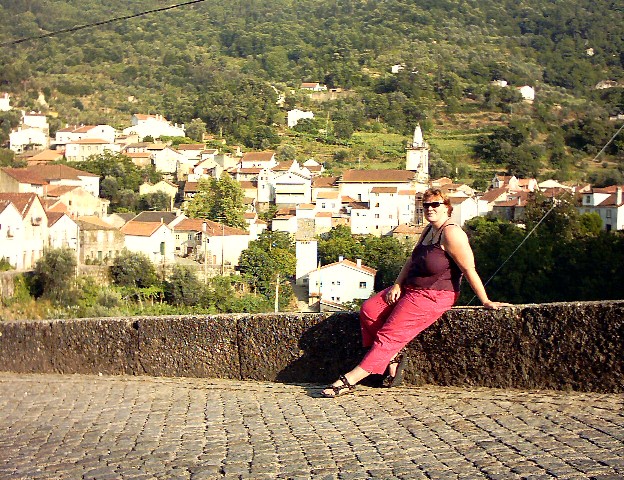 With a pressing desire to head
south for morocco, we drove south over the next couple of days, stopping briefly
at the small town of San Giao for the night before finally arriving at
Lisbon. Here we spent a couple of days being tourists; walking up to the Castello on the hill overlooking the town, with fine views over the Tagus, and
visiting the Torre & Monesteiro at Belem (although being a Monday they were both
shut). Driving in Portugal proved something of a challenge - no wonder they have
the worst road accident rates in Europe - as drivers seemingly regard traffic
lights as being merely colourful ornaments with no obvious function. From Lisbon
we drove flat-out again until we reached Gibraltar, where we decided to park the
car for a few weeks whilst we explored Morocco. Unfortunately, since the ferry
to Tangier had been suspended a few months ago, we had to take a bus to the
Spanish port of Algeciras in order to catch the ferry across the Strait of
Gibraltar.
With a pressing desire to head
south for morocco, we drove south over the next couple of days, stopping briefly
at the small town of San Giao for the night before finally arriving at
Lisbon. Here we spent a couple of days being tourists; walking up to the Castello on the hill overlooking the town, with fine views over the Tagus, and
visiting the Torre & Monesteiro at Belem (although being a Monday they were both
shut). Driving in Portugal proved something of a challenge - no wonder they have
the worst road accident rates in Europe - as drivers seemingly regard traffic
lights as being merely colourful ornaments with no obvious function. From Lisbon
we drove flat-out again until we reached Gibraltar, where we decided to park the
car for a few weeks whilst we explored Morocco. Unfortunately, since the ferry
to Tangier had been suspended a few months ago, we had to take a bus to the
Spanish port of Algeciras in order to catch the ferry across the Strait of
Gibraltar.
Morocco & Gibraltar - August 2002
Arriving in Morocco proved to be a shock to the senses - and again made us wish we could speak at least some French, which is widely spoken here. Deciding to get out of Tangier we made our way to the bus station and caught a bus to Tetuan, employing the time honoured method of standing around looking lost & confused, whereupon some kindly soul took pity on us and sorted us out with tickets & pushed us onto the right bus.
From Tetuan we travelled to Rabat and spent some time exploring the medina & old walled Kasbah whilst getting to grips with the differences in culture & cuisine - Harira (a thick veg. broth) is great, but I'm still not overly struck with couscous.
We then too k a train down to Marrakech - nothing like the song at all (no goats & chickens), in fact it was all very plush & comfortable with squidgy seats & air con. There we found a place to stay in the medina, just off the 'Place Djemaa el Fna', where every evening food stalls are set up selling everything imaginable (and sometimes unspeakable). Competing for attention in the square are also to be found an assortment of snake charmers, dentists, acrobats, story tellers & various lunatics - in fact everything you could possibly need for an evening's entertainment. The temperature in Marrakech was overpowering (at ~45 degrees) so we decided to head for the hills to do some serious walking (as opposed to the silly kind) - ending up at the village of Imlil in the High Atlas mountains.


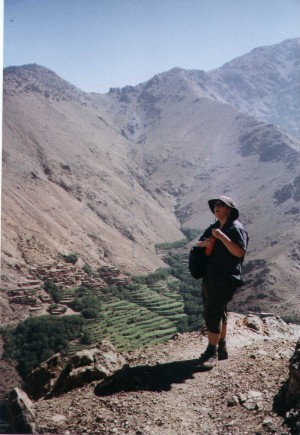

Here, in the shadow of Jbel Toubkal (Morocco's highest peak) we spent time exploring the valleys and Berber villages clinging to the steep hillsides during day walks. We also hired a mule for a short trek into some neighbouring valleys, which made light work of carrying our backpacks, and allowed us to get away from it all for a bit.
 After our brief
spell in the mountains we returned to the heat of Marrakech, before heading
north to the town of Fez. Here we spent a couple of days exploring the old town
before deciding to return to Spain, feeling exhausted by the heat (maybe August
wasn't the best time of year to visit Morocco) and a bit travel weary - Morocco
having not really lived up to expectations for us at all, the general feeling
being that we seemed to be viewed by too many people as sheep waiting to be
fleeced. So we caught the ferry back to Algeciras and then spent a few days in
Gibraltar, exploring the rock and enjoying some good old English pub grub,
before stocking up on a few essential supplies (Baked beans, veggie sausages
etc) and heading back into Spain.
After our brief
spell in the mountains we returned to the heat of Marrakech, before heading
north to the town of Fez. Here we spent a couple of days exploring the old town
before deciding to return to Spain, feeling exhausted by the heat (maybe August
wasn't the best time of year to visit Morocco) and a bit travel weary - Morocco
having not really lived up to expectations for us at all, the general feeling
being that we seemed to be viewed by too many people as sheep waiting to be
fleeced. So we caught the ferry back to Algeciras and then spent a few days in
Gibraltar, exploring the rock and enjoying some good old English pub grub,
before stocking up on a few essential supplies (Baked beans, veggie sausages
etc) and heading back into Spain.
Spain (again) - August / September 2002
Once back in Spain we drove east along the south coast to Almeria (where they filmed the Spaghetti westerns) with a fist full of Euros again. Although, having just come from Morocco we didn't find the landscape too inspiring - mostly desert (we should have known really) - so we travelled west again, ending up in Ronda.
 Here we enjoyed a relaxing time walking in the green
rolling hills and having a bit of a holiday. Ronda itself is a beautiful old
town, set astride a deep gorge with bridges connecting one side to the other;
in fact the whole area is littered with hidden gorges and deep caves, making
for quite a striking landscape. We then called at Malaga airport to pick Simon &
Janet up and drove to the remote village of Acequias (15 miles south of Granada)
in the heart of the Sierra Nevada, where we'd booked a cottage for a couple of
weeks. Here we had a fantastic time, living in the lap of luxury (soft beds,
fridge & Satellite TV) and exploring this mountainous region. Often we'd go off
for day walks in the surrounding hills, usually ending up in a local village bar
for beer & tapas. Had a couple of days in Granada as well, exploring the town &
visiting the Alhambra - a stunning hilltop Moorish palace/fortress, built before
the Christian conquest of Spain.
Here we enjoyed a relaxing time walking in the green
rolling hills and having a bit of a holiday. Ronda itself is a beautiful old
town, set astride a deep gorge with bridges connecting one side to the other;
in fact the whole area is littered with hidden gorges and deep caves, making
for quite a striking landscape. We then called at Malaga airport to pick Simon &
Janet up and drove to the remote village of Acequias (15 miles south of Granada)
in the heart of the Sierra Nevada, where we'd booked a cottage for a couple of
weeks. Here we had a fantastic time, living in the lap of luxury (soft beds,
fridge & Satellite TV) and exploring this mountainous region. Often we'd go off
for day walks in the surrounding hills, usually ending up in a local village bar
for beer & tapas. Had a couple of days in Granada as well, exploring the town &
visiting the Alhambra - a stunning hilltop Moorish palace/fortress, built before
the Christian conquest of Spain.
After dropping Simon & Janet off at the airport we drove north, skirting round Madrid and ending up in Barcelona. Here we soaked up the city's vibrant atmosphere and enjoyed discovering little bars & cafes in the side streets off La Rambla. Visited 'La Familia Sagrada', Gaudi's incredible cathedral, still under construction after 120 years - a fantastic building that seems more to be growing than being built - in fact bits of it wouldn't look out of place in the Natural History museum. We climbed high up into some of the already completed towers, from where I'm told there are superb views across the city - if you're brave enough to look (I just became curiously interested in looking at my feet instead). Also wandered around the 'Parc Guell' where we discovered some stunning Gaudi mosaics and whimsical 'ginger bread' houses - all very surreal. The weather here at last seemed to be turning, as we had an amazing thunderstorm whilst camping here - in fact I'm amazed the tent survived since there now seems to be more patches than tent.
We left Barcelona and, driving through the night, entered Italy (another country of suicidal drivers) and headed for Pisa. Here we had a few days exploring Pisa & Florence - including a very cultural day in the Uffizi gallery (getting our fill of 'Annunciations') - before driving across to Venice.
Here we camped on a campsite just south of Venice - seemingly full of young Australians who were evidently intent on drinking their way around Europe (or maybe I'm just getting middle-aged). Italy too seemed to be much more expensive than Spain, so we decided to whiz through the country rather quickly. We did however, have a few rather wet days exploring Venice - where even the Piazza S.Marco was entirely flooded, which somewhat dampened the orchestra. The Basilica of San Marco was stunning though, with an amazing tiled mosaic floor and the walls dripping with gold. The museum inside was a bit more macabre however, with a bizarre collection of bits of dead saintly dudes - ranging from odd fingers to entire skulls in various jars and caskets. There was also an amazing collection of loot here too, stolen from Sancta Sophia in Istanbul during the later Crusades - when the Crusaders, having decided that Jerusalem was maybe a bit too dangerous a place to be at the time, decided take home a few souvenirs from Constantinople instead.
We then headed south to Rome, and had fun for a couple of days rummaging around the Coliseum, the Forum and the Vatican (a few too many Cherubs for our liking) before moving on to Pompeii where we had a full day exploring the site. There seemed to be much more here that's open to the public than when I was last here 12 years ago, and the mosaics & paintings that can be seen inside some of the houses are absolutely stunning.
Our final drive in our trusty old car took us down to Brindisi, whereupon we (somehow) emptied the contents of the car into 2 rucksacks and left the car to its fate - it having safely taken us an amazing 7,301 miles since leaving home (without a single accident !)
We took the overnight ferry from Brindisi to Patras, and then caught the next ferry on to the island of Kefallonia in the Ionian sea. Kefallonia is a remarkably green and mountainous island, and we spent the best part of a week here, walking in the hills and relaxing. Whilst also trying to figure out what we could lose out of our overweight rucksacks. It was a good feeling to be back in Greece, a country that we keep coming back to time and time again, and it was a shame that we couldn't have stayed longer. It was here though during a particularly rainy night, that the tent finally gave out on us, so the next day we promptly moved into a dry rented room and chucked the tent in the bin - at least it was one less thing to carry.
From Kefallonia we went back to Patras and caught the night train to Athens. Now the plan here was to get the ferry to Cyprus and then on to Egypt, but it turned out that the ferries to Cyprus were no longer running. So, deciding to go the long way round via Turkey & the Middle East, we caught the afternoon train to Istanbul - arriving there tired and smelly sometime the following evening.
It felt good to be back in Istanbul, it being several years since we were last here, and instantly felt at home. However, there seamed an increasing urgency to push down into the Middle East (before that moronic President 'Boy George' starts his ill-conceived, utterly pointless (except to grab the oil) and no doubt ultimately disastrous war of terror !), so most of our time here seemed to be spent visiting embassies and filling in forms. Having not been able to arrange any visas before leaving home (i.e. they would have expired long before we could have used them), this also required us to visit the British Embassy too in order to acquire a 'letter of recommendation' to present to the Syrian Embassy - a costly and time consuming affair.
So finally, with Syrian visas stamped into our passports we took a long distance bus south to the town of Fethiye on the Mediterranean coast. The buses in Turkey are great, they're (generally) very comfortable, you get pampered en route with cups of tea or coffee and biscuits, and they splash liberal helpings of lemon scented cologne over you to freshen you up every few hours or so. On top of that they're very cheap and go absolutely everywhere (and only occasionally crash). Down in the south of Turkey the temperature had soured into the 30's again which is rather pleasant for late October, and we managed to do some walking along this incredibly beautiful (and relatively unspoilt) coastline - including bits of the Lycian Way, Turkey's first long distance path. There's also an incredible amount of archaeology to be (literally) stumbled upon around here (Lycian cities, Roman amphitheatres, deserted Greek villages etc) which makes strolling around the region even more fascinating.
At the moment we're staying in the pleasant relaxed coastal town of Kaş, where we plan to do a bit more exploring, before heading down to Antakya
and then over into Syria sometime next week. However, given that the Internet is
effectively banned in Syria, it'll probably be from either Jordan or Egypt when
you'll next hear from us.
Saturday 23rd November 2002 update - Dahab, Egypt.
The journey from Kaş involved a change at Antalya before getting the overnight bus to Antakya (Biblical Antioch) close to the Syrian border.
Its hard to get any sleep on overnight bus journeys and the route took us inland, via Konya, which was distinctly chilly in the middle of the night. We originally intended spending the night at Antakya before heading over the border, but we were not too inspired by the sprawling, polluted mayhem of the place, so we decided to push on - maybe we'll spend more time here when we come back this way in a couple of month's time.
The bus over the Syrian border was a relatively painless affair, with only a cursory prodding of our luggage by customs officials on the way, and we arrived in Aleppo tired and in need of a wash later o n that day.
The first thing that struck us about Syria was how friendly the people were; you can't walk down the street without at least a few dozen people waving at you and saying hello - a stark contrast to London. And within a few hours of arriving we were befriended by a couple of young lads who plied us with limitless quantities of tea and pomegranate back at their place.
We spent a couple of days here in Aleppo, exploring the magnificent Citadel which dominates the old town from its hilltop position, and the labyrinthine souq with its medieval vaulted ceilings and shops selling pretty much anything you could imagine. And unlike the souqs and bazaars of more 'touristy' places (e.g. Istanbul), there was far less of the hard sell - shop owners were genuinely pleased if you just stopped by for a long chat over several cups of tea .
From Aleppo we caught the bus south to Hama, a small town on the road to Damascus noted for its huge, creaking waterwheels down by the river, used to irrigate the surrounding farmland - water being a precious commodity in this part of the world.
Here we made a day trip out to the Roman ruins of Apamea, with its stunning 2 km long colonnaded main street which was largely intact, and were among only a handful of other visitors that day as we explored the ruins.
We also had a day out to the impressive Crusader fortress of 'Krak des Chavaliers', described by T E Lawrence simply as "the finest castle in the world". We certainly weren't disappointed: the castle is almost entirely intact, having never fallen to invading armies (it was simply abandoned when the Crusaders realized they had lost the Holy Land), and probably looks the same today as it would have 800 years ago.
From Hama we headed east into the desert to the oasis town of Palmyra; originally a Greek outpost it rose to become a city of unsurpassed wealth during Roman times. Despite numerous earthquakes and erosion over time, so much of the city remains that we spent several days exploring the site. Built mainly from red sandstone, it looked stunning in its desert setting, overlooked by a hilltop Moslem fortress and with numerous funery towers disappearing into the distance in the valley beyond.
Coming into Damascus from such a tranquil setting proved to be something of a shock. Damascus is a huge, sprawling and polluted city, too large in fact for the narrow valley it rests in that it has spread up the steep-sided valley walls - when you can see them through the smog, that is. After obtaining our Jordanian visas from the embassy here we had some time to explore the old city, visiting the souq and the ' Umayyad mosque' which dominates this part of town. The building, built on the site of a Roman temple (some Roman masonry can still be seen in the walls of the mosque itself), was first a Byzantine church before being converted into a mosque in the 7th century. In fact it was here that the head of John the Baptist (preserved in a casket) was said to have once been held - his right arm being sent off to Istanbul (where it can still be seen, if you care to look), proving that arms smuggling is nothing new. As one of the earliest mosques in the world it has weathered well, despite invading Mongols and the ravages of earthquake and fire, and what remains is certainly impressive, and is a great place to just sit and contemplate the world.
We took a direct bus from Damascus to Amman in Jordan, only being held up at the border for an hour or so. The monumental sprawl of Amman didn't impress us much (although it did contain a rather good 'Pizza Hut'), so we got the first bus out the following day to Wadi Musa, a village near the site of Petra.
It rained quite heavily soon after we'd arrived, the first rain we'd felt since leaving Istanbul, so maybe Winter is finally catching up with us after all. Its noticeably cooler here in the evenings too, requiring a jacket at least, although through the day the temperature still soars into the 30's.
Our arrival here also coincided with the start of Ramadan, making eating during the day from now on somewhat problematic. Although it is quite acceptable to buy food from the supermarkets and bakeries, eating it in public would be rudely insensitive. So for the next month we will have to eat either back at our hotel room or at least out of view from anyone else, since no cafes will be open during the day. At least, being Winter, the days are shorter than they otherwise might be - when Ramadan falls during the Summer months it must be a particularly trying experience for all concerned.
The first time we visited Petra was a memorable experience; the entrance leads down a narrow gorge (siq), cut out of the most amazingly coloured layers of red sandstone. However, as you near its end tantalizing glimpses of an immense tomb, carved into the rock face, catches your eye - if you've ever seen the final scenes of 'Indiana Jones and the last crusade' you'll know what I'm talking about. This tomb, which is one of many, was carved out of the sandstone by the Nabateans when they came to settle here in the 7th century BC. The town was later occupied by the Romans (who else ?) who added the usual array of colonnaded streets, amphitheatres, temples etc, of which much still remains. The Crusaders were briefly here and built a fortress, but since then it became a forgotten city, known only to the local Bedouin, until its rediscovery in the 19th century. The site is still being excavated, and we found the remains of a Byzantine era church with the most incredibly well preserved mosaic floor, which had only been discovered a couple of years ago. Needless to say, we spent several days exploring every inch of the site and climbing the nearby hills, from where the views of the surrounding landscape are truly magnificent (I'm going to have to think of some different adjectives).
From Petra we booked a jeep trip into the desert around Wadi Rum, camping out overnight in the desert. In fact we enjoyed the tranquillity of the desert so much that we decided to stay out there for a few days more and do some walking. So, with our friendly Bedouin guide (Aodeh) returning each night to light our camp fire and cook some dinner, the rest of the time we had the desert practically to ourselves. Whilst walking in the desert (not always the easiest thing to do) we encountered the occasional Bedouin, out with their camels and tending their goats, and even a large group of Oryx. The night sky was particularly amazing, with so many stars (how do they manage to fit them all in ?) lighting up the desert landscape of eerie rock formations and sand dunes.
Sadly, but in desperate need of a good wash, we left to move on to Aqaba - giving up on the original idea of riding there by camel (a la T E Lawrence) and taking the bus instead. The setting of Aqaba is quite striking in itself, sitting as it does in that narrow point where Jordan meets the sea. Behind it are a range of high barren mountains, and from our hotel balcony we could look out across the Gulf of Aqaba and see the port of Eilat (in Israel) to our right and the high mountains of Sinai (in Egypt) in front of us across the bay. With the Saudi border being only a few miles up the coast too, Aqaba has had little room to expand, and it remains a small relaxed town with a faintly Mediterranean feel.
So we spent a couple of days here relaxing, and attempting (though unsuccessfully) to wash some of the desert out of our clothes, before catching the ferry across to the Egyptian port of Nuweiba.
Egypt - November / December 2002
The ferry across to Egypt proved to be a confusing affair, compounded, no doubt, by our having to obtain visas for Egypt on arrival at the port. However, once we'd passed through immigration we headed down to the small coastal town of Dahab.
It feels like a different world here, and a real travellers centre with a very laid-back feel to it - even the effects of Ramadan are hardly in evidence here as the sounds of Bob Marley and David Gray compete for attention with the call to prayers from the local mosque. And all along the ba y is a string of beach-front restaurants serving anything you want - we even had an Indian a couple of days ago, and Claire's lapping up all the fresh fish and seafood - and there's even plenty of cheap beer.
Its also a major diving and snorkling centre, and Claire's already been out with her flippers (or whatever you call them) and reckons its amazing: plenty of coral and exotically colourful fish. So we're planning on having a little holiday and staying on here for a few days yet, treating it as a nice gentle introduction to Egypt before heading on to Cairo to do some serious monument hunting.
I think that we're going to head then up the Nile to Luxor and Aswan (and hopefully Abu Simbel), before coming back here for a few days to rest again. After that its back over the gulf to Jordan and Syria to see all the places we missed on the way down, before ending up in Turkey for Christmas (what else ?).
.. And don't forget to keep on emailing /
texting us, you'll never know how great it is to hear from folk when we're so
far from home.
Wednesday 29th January 2003 update - Istanbul, Turkey.
Well, we finally moved on after a week or so from Dahab and took the bus direct to Cairo. The ten hour journey followed the coastline of Sinai, south to Sharm el Sheik before turning north to Suez. Sinai itself seemed to consist of an extremely barren interior - no doubt accounting for its 'wilderness' tag in Biblical times - and a bleak sandy coast punctuated by the occasional resort-type complex, mostly deserted or only half built. We stopped at roadside cafes a couple of times throughout the day to stretch our legs, but since it was still Ramadan there were no refreshments on offer (napkins were still available though). Suez too proved to be a disappointment, since the ro ad went through a tunnel underneath, and offered not even a glimps of the Canal. But we eventually crawled into Cairo a couple of hours later after fighting our way through the traffic jams.
Once installed in Cairo we spent a full afternoon at the Egyptian Museum, losing ourselves amongst the vast collection held there - after all Egypt must be the only country to have an '-ology' all to itself. Half the upper floor was devoted to the spectactular funnery treasures of Tutenkhamun, discovered only 80 years ago, and surprisingly not pilfered by the British to be subsequently displayed in the British Museum.
The streets of downtown Cairo became alive in the evenings with throngs of people out shopping, eating or just wandering about. And we got quite addicted to the local 'fast food' speciality, Kushari - a delicious mixture of noodles, rice, macaroni, lentils, chickpeas and onion - sold in foil tubs or ta ke-away plastic bags; Egypt's answer to fish 'n' chips.
The next day we took the bus to Giza - now a suburb of the ever expanding Cairo - to see those strange pointy things on the edge of the desert.
I don't think anything could quite prepare us for the awesome sight of these gigantic man-made mountains that loomed over us, nor I suspect can anything I write here do them any justice. So the words of one camel owner nearby who apparantly said, "they're very big and very old" are as apt as any I suppose.
We climbed a hill to the west and sat for a long time gazing at the scene before us, and watching with mild amusement the coach loads of camera clicking tourists who were allowed to get out of there comfy seats for a few minutes before being whisked away again to see the next site. In fact the only thing which spoilt the tranquillity of the whole scene was the endless convoy of tourist coaches that ploughed up and down a newly constructed road which actually ran up between the Pyramids - but, I guess, in the eyes of the Egyptian tourist board more is definitely better.
Walking back down to take a closer look, passing tourist policemen who either invited us to climb up on the stones (if we proffered the appropriate baksheesh) or blew whistles apoplectically at folk who were actually standing on them, we came to the entrance of Chephren's Pyramid and paid to go inside.
The narrow entrance tunnel descended slowly into the Pyramid, then turned upwards again and narrowed even further to about a yard square, causing us to shuffle along on our bottoms. Finally we emerged at the central burial chamber, a surprisingly large room - and still bearing Chephren's outer sarcophagus - which was nonetheless incredibly airless and hot, and definitely not a place for claustrophobes. Being at the heart of such an enormous and ancient structure was an incredible feeling; hard to describe but certainly not one to forget.
Moving on again we took the night train to Aswan, following the course of the Nile south. Aswan is a pleasant small town lying on the east bank, with fine views across the Nile where feluccas can be seen gracefully sailing around the many islets found here. We spent a few days exploring, crossing over to the west bank to visit the wonderfully preserved monastery of St. Simeon (he who achieved sainthood by standing on a pillar for 30 years) situated on the edge of the desert sands, and found ourselves to be the sole visitors. The mausoleum of the Aga Khan also lies nearby, but we were prevented from getting too close to it by a policeman who rattled his gun at us.
In fact the twitchiness of the police was very evident here, with heavily armed paramilitary police stationed behind bullet proof shields on every street corner eager to keep tourists exactly where they could see them. No doubt this is a consequence of the 1997 massacre of a coach load of German tourists in Luxor by Islamist extremists intent on specifically targeting tourists, and thus Egypt's main source of revenue.
This feeling was further reinforced when we made the trip south to the temple complex of Abu Simbel and were made to travel the whole way in armed convoy. The trip was certainly worth it however, and the sight of the giant statues of Ramses II staring out across the desert were incredible. The inner chambers of the temple were superbly decorated with large scale drawings of the gods and Ramses II in suitably heroic poses, the colours of which had remained surprisingly vivid after over three thousand years.
But, perhaps the most mind-boggling thing of all was the very fact that the entire complex had been moved, stone by stone, w hen the Aswan High dam was constructed in the 1960's, and relocated on the higher ground of its present site as part of an UNESCO project to save it from the ensuing flood.
We sailed gently down river from Aswan on the following few days on board a felucca; one of those small, graceful, single-sailed boats that inhabit the Nile. This was an exceptionally tranquil experience, watching life going on around us on the river banks by day and star gazing by night, eating and sleeping on board as we drifted slowly northwards down the Nile towards Edfu.
After a brief visit to the temple of Horus at Edfu we continued north by bus to Luxor, arriving there at the end of Ramadan, the Eid el Fitr. For 3 days the town was alive with festivity and the streets crowded with people, boys on horseback, food stalls and tinsel banners overhead.
Eventually the chaos subsided and things returned to normal, or at least as normal as Luxor ever gets. Now presumably because of its long history of mass-tourism and the effect this has had on the Egyptian people, but Luxor to our minds is now equated with hassle. Mark Twain commented on this too when he visited in 1866 and claimed to have "suffered torture that no pen can describe from the hungry appeals for baksheesh that gleamed from Arab eyes". And the aggressiveness of some of the touts here is certainly the most extreme we've witnessed so far, and was a stark contrast to our reception in Syrıa and Jordan where we were treated, almost without exception, fairly and with a friendly respect. But here we found that even a casual stroll down the main street would provoke endless calls for felucca rides, taxis or baksheesh every few yards or so, and despite being generally amiable about the inevitable banter that ensues, it does at times get beyond a joke to the extent where tempers can get somewhat frayed. And even buying something as apparently straightforward as a falafel sandwich could prove to be trying at times, since the price quoted to you was often more a reflection of how much money the vendor thought you had on you than on how much it was actually worth. Now we wouldn't have minded just paying more for visiting tourist sites or using public transport, in fact it would seem quite fair in places to pay more than the locals, but when you have to argue over the cost of every basic item you buy life gets to be very wearisome indeed.
Hassles aside, there was plenty of other things to keep us occupied here. We spent a full day across on the west bank and visited 'The Valley of the Kings'. Here in this otherwise barren valley lie the tombs of dozens of past rulers of ancient Egypt who were buried here along with vast treasures. Most of which have been robbed over the passing centuries (or sometimes only years after being sealed) de spite the often elaborate mechanisms employed to safeguard their contents, involving hidden precipices and misleading tunnels. What remains, however, is the stunningly decorated walls and ceilings of the tunnels and burial chambers themselves; heavily symbolic art depicting both humans and gods, and of course, never intended to be seen again by us mere mortals.
Most of the 'package tourists' were dragged around only a handful of these tombs, so by going to places they didn't visit we were able to wander peacefully at our own pace away from the crowds and spend some quality time exploring.
Another highlight of Luxor was Luxor temple itself. The double row of Sphinxes leading to the temple entrance was dramatic enough, but the shear size and beauty of some of the statues inside took our breath away. Together with the remarkably intact temple structure itself, this was an unexpected gem right in the centre of town and illuminated each evening to great effect.
Karnak temple, a few miles to the north, couldn't fail to impress due to its ambitious scale - and it took us a whole day to take it all in - with its forest of pillars, huge pylons, obelisks and staues scattered over a very wide area.
Our only gripe here was with the overly helpful (and self appointed ?) guides who would persistently shuffle along after us, pointing out the bloody obvious (yes, we know its a pillar) and then demand some baksheesh for their trouble, which made it infuriatingly difficult at times to quietly contemplate all that was around us.
We only had a few more days left before our one-month visa expired, and on deciding to avoid re-visiting Cairo, we chose to take the direct bus back to Dahab. This was an appalling 17 hour journey in cramped seats, and one we'd rather forget.
Dahab was still as mellow as ever which made for a pleasant end to our Egyptian jaunt, although as it was noticably cooler here than it was a few weeks ago there was a definite 'end of summer' feeling, and now that we were heading further north things were about to get colder still.
We left Egypt on a rather sour note too. We missed the boat to Aqaba that we had intended to take due to being buggered about on the bus from Dahab to the port of Nuweiba which took far longer than we were assured it would. At Nuweiba we were then forced to take the later (and of course, much more expensive) catamaran instead, and to agravate matters further they refused payment in Egyptian Pounds and insisted that we bought our tickets in US Dollars. So we left Egypt feeling angry and entirely ripped off.
Jordan and Syria (again) - December 2002
On arrival at Aqaba we found a bus waiting to depart for Amman and so jumped aboard and arrived there later that night. Feeling tired and uninspired we couldn't face the planned visit to Jerash, and so soon moved on again across the Syrian border to Damascus, where our feet barely touched the ground as we took the first bus we could north from here to Aleppo. Here there was a definite chill to the air, causing us to break out our thermal underwear and fleece jumpers for the first time. It also became apparent that I'd picked up some 'flu-like' thingy, and so was confined to bed for a couple of days whilst Claire played nursie.
So it was partly because of that, but also due to a general state of travel weariness that we decided to leave the planned visit to the Crusader fort near Latakia for another time and move on north again, back into Turkey where we could relax a bit and prepare ourselves for the next leg of the journey.
Turkey (again) - December 2002 / January 2003
It was only a short bus ride over the Turkish border to Antakya but was quite entertaining enough at the border itself as we watched sacks of contraband being hurriedly switched between cars whilst the Customs officers' backs were turned. From Antakya we took the night bus to Ankara, where the temperature couldn't have been much above freezing and the city seemed to be covered in a thick layer of ice - which came as a bit of a shock to our systems since we seem to have managed to spend most of the past 6 months in continual Summer.
The reason for visiting Ankara was to investigate getting visas for our onward travel. But while the Pakistani embassy quite happily handed us the application forms, the Iranian embassy bluntly told us that it couldn't issue us with visas without authorization which could only be obtained from within Iran itself. For us this would involve contacting a travel agency in Tehran who, for a price, would apply on our behalf to the Ministry of the Interior for a Visa Application Number. Should this be successful we would then be able to call into a nominated Iranian embassy and, for a further fee, receive our tourist visas. So we fired a few emails off to various travel agents in Tehran and hopped on a bus to Cappadocia where we could enjoy a Christmas break and await any news about visas.
So Christmas was spent loafing about at a cosy little place in Göreme, which lies at the heart of the unique scenery of Cappadocia. Here the soft volcanic rocky landscape has been weathered over the millennia by wind and water and been shaped into the most bizarre formations imaginable. And it was here too that early Christians sought shelter and safety by carving out homes and churches from the rock itself, and then later building entire cities underground to escape persecution from invaders that swept across from the east. Many of these Troglodyte dwellings can still be seen today (in fact the Pension we were staying in was half built into the rock), and we spent several days exploring some of the nearby valleys. Although, as several feet of snow had landed here since our arrival we were unable at times to venture too far - but at least that gave us a suitable excuse to surrender to the festive spirit by eating and drinking to excess.
It was also around this time that our future travel plans changed somewhat. We had received some replies from Tehran and it appeared that the cost of obtaining visas for Iran was going to be pretty steep. Also, the FCO was currently advising "against all but essential" to Pakistan, which meant that out travel insurance would be void if we went there. So with our intended land route blocked and all the alternatives contemplated, we finally decided to fly to India from here. This was quite a blow to us as we had both been looking forward to visiting Iran and Pakistan, and I certainly had hoped to keep my feet firmly on the ground throughout our trip, but hopefully the situation there will improve in the near future and make visiting possible (I can sense another trip being planned)..
We spent a few days around New Year south of Cappadocia at the pretty town of Egirdir in Turkey's Lake District. Situated on the edge of a huge lake and surrounded by high mountains this was certainly an idyllic spot, although bitterly cold and quiet at this time of year. On one day, however, the sun came out and we managed to climb up the hill overlooking the town from where there were some impressive views. Feeling the need for a bit of warmth we headed south again to the Mediterranean coast, and the only bit of Turkey that doesn't really have a winter as such..
Arriving in Antalya was very pleasant indeed - off came the thermal underware and on went the sunglasses - although not exactly hot, the temperature here was a rather nice 20 degrees or so, which cheared us up no end. It was here too that mine and Claire's mums flew out to spend a week's holiday with us, which was a real tonic and gave us the excuse to live it up a bit and do a few touristy things. We hired a car for 3 days and visited a few places, including the Roman site of Tremessos, dramatically situated high up in the Taurus mountains, and the old port of Phaselis set around a tranquil bay. It was also nice to have someone else to talk to for a change, despite the fact that Claire and I are still (amazingly enough) talking to one another..
After 'the Mums' had flown back home the rain set in, so we took it as a sign to leave too and headed back to Istanbul. We've been in Istanbul now for just over a week, filling in our time by flicking through our Ind ian guide book and catching the latest releases at the local cinema, in between several visits to the Indian embassy. Hopefully, we'll be able to pick up our visas later today, which is cutting it a bit fine since we're due to fly out to New Delhi in 2 days time on 31 January. So, all being well (war in the Middle East included), we'll be in India from 1st February onwards - hopefully for some time, as there's much we're wanting to do there..
In the
meantime, keep those emails and text messages coming (they're muchly
appreciated), and we'll post a mailing address for us in New Delhi as soon as we
know what it is ourselves..
Friday 11th April 2003 update - New Delhi, India.
Well, the Indian visas came through just in time after serveral anxious visits to the embassy (there's nothing quite like leaving things til the last minute, is there ?) and we finally flew o ut of Istanbul on 31st Jan, having personally consumed most of the 'duty free' beforehand to stop my knees from shaking. The flight involved a stop over, oddly enough, in Amman where we were put up in a hotel (to be fed & watered) for a few hours before continuing our flight to Delhi.
We arrived at New Delhi the following morning, and after being re-united with our bags - an event that rarely fails to surprise me (failing, generally, when they disappear totally without trace. NB. Don't ever fly Air France) - we caught the bus into the centre of town.
Delhi is a chaotic city, and as we crawled slowly through the endless traffic jams and heavy clouds of pollution towards Connaught Place we began to wonder why on earth we had come here to one of the most depressingly polluted cities on the planet - in a country that also contains many runners up. We were also feeling tired and jet lagged, and mentally unprepared for the crushing multitudes, scenes of monumental squalor, endless rip-off scams (shoe shine boys chucking handfuls of muck at Claire's shoes, before asking her if she wanted them cleaned, was an ingenious one we thought), and constant demands for our time and/or money.
So the following day, after seeking some temporary relief in the air-conditioned heaven of 'Pizza Hut', we decided that we could explore the delights of Delhi at some later date - of which there were likely to be several - and leave town as soon as possible. So having formulated no plan whatsoever, other than that of leaving, we took a bus the following day to Jaipur in Rajasthan.
Jaipur, 'The Pink City', is also a horrendously overcrowded and polluted urban sprawl, though admittedly in a different colour and not wholly without some degree of charm. And once within the confines of the old city wall it's just about possible to catch the odd glimpse of its former glory. Built in the early 18th century by the Maharaja Jai Singh when he decided to move down from his hill palace at nearby Amber when Mughal power began to wane, and constructed a new palace which is still (in part) occupied by his descendants. The whole town was painted pink - a colour associated with hospitality - to welcome the Prince of Wales (before he became Edward VII) who visited in the late 19th Century, and the colour seems to have stuck.
The main city palace covers a large (and peaceful) area consisting of several courtyards and buildings in a mixture of Rajput and Mughal styles, some of which are now museums containing assorted princely oddities - such as the two enormous silver pots in which a former Maharaja used to carry gallons of holy Ganges water on a visit to England, preferring not to risk the English water - and having tasted London water I can't blame him.
The famous Hawa Mahal (Palace of the Winds) is a central landmark in town, overlooking a busy street. Consisting of little more than a facade there's little to see inside, but the impressive five storey structure with its delicately carved sandstone windows and turrets - designed so that women from the Royal household could look out without themselves being seen - offered fine views across the city.
One of the most delightfully odd places we visited in Jaipur was the Jantar Mantar or Observatory, and Jai Singh, who was an enthusiastic astronomer, liked to build on an impressive scale. What at first appears to be a bizarre collection of surreal sculptures, on closer inspection turn out to be a series of giant astronomical measuring instruments constructed out of stone. The most impressive (and surely the largest in the world) being a 30m high sun dial.
Taking a rickshaw to Amber, a few miles to the north, we visited the old palace fort capital. Looking as you would expect a Rajput fort to look, stunningly situated on a hill top overlooking rolling sandy hills, it certainly doesn't disappoint. Inside we wandered through the courtyards and Maharaja's apartments, with their latticed galleries, mosaics and mirrored ceilings, thankfully now being restored after decades of neglect.
Having spent much of the last few months in places that certainly don't suffer from a shortage of sand, and finding ourselves once more in a desert, a plan slowly began to form to head further south to where it should be lush and green for a change. To this end we joined the queue at the Railway Station for 'Freedom Fighters & Foreign Tourists' (no kidding !) and reserved 2 berths on an overnight train from Bombay to Margao in Goa for 2 weeks time - it being impossible to book anything sooner since it appears that at least half the population of India is constantly on the move. So with that in mind we decided to drift slowly southwards over the next fortnight, calling at a few places on the way down to Bombay.
We spent a few days in Pushkar, a pleasant small town, thankfully devoid of much traffic, and set alongside a tranquil lake. It's also a pilgrimage centre for devout Hindus, and so has a collection of interesting (though none too old) temples and bathing ghats down by the lakeside. It's also a bit of a 'traveller's scene', and usually full of 'lost' westerners trying hard to find themselves, though it was oddly quiet whilst we were there - maybe they've all found themselves by now.
We then took a bus south from here to the small town of Bundi, along what must be one of the most pot-holed roads in the world, merrily bouncing along on the back seat with our luggage strapped to the roof. Bundi is a quiet town in a steep sided valley that probably hasn't altered all that much for centuries; narrow winding streets meander through old blue painted houses, with the imposing Rajput fort and palace brooding overhead. The locals were exceptionally friendly too, evidently not much used to western tourists, and only too keen to stop and chat. Unfortunately, with India still being basically a Cricket worshiping nation, most of the conversations revolved around the World Cup. And as we both know less than nothing about the sport, most people probably thought us either mad or just plain stupid.
From Bundi we took a couple of short train rides (avoiding the appalling roads for once) to the town of Udaipur in the south of Rajasthan. Udaipur is, without doubt, one of India's most stunning cities, set around a large lake and surrounded by gentle barren hills. There are several Maharaja's palaces here t oo, some now converted into luxury hotels, including the famous one set on an island in the lake itself. The city exudes a whimsical Rajput charm (I don't work for the Indian tourist board, honestly) around the old town near the lake, containing numerous elegant palaces, havelis (mansions) and temples - the modern urban sprawl extending beyond the old town being the usual polluted mess and is probably best avoided.
Udaipur is also famous for its arts and crafts, and we had the opportunity of watching a performance of Rajasthani folk dancing at a restored haveli one night, and Claire turned her hand to miniature painting in the Rajput-Mughal-Persian style under the guidance of a local artist.
By now it was getting on for the time that we needed to be in Bombay, so we took an overnight bus from Udaipur. Buses in India can be an exhilarating experience, albeit a sometimes terrifying one. Driving usually involves flooring the accelerator and sounding the horn every 5 seconds or so to make sure that people get out of your way in time. In theory, at least, they drive on the left; in practice they drive in the middle of the road where there's fewer potholes. When any other vehicle is encountered coming the other way, the lesser of the two vehicles is expected to swerve (at the last second) apologetically out of the way. Misunderstandings here as to the relative status of the vehicles concerned can have unfortunate consequences. When driving at night, unlike in Cairo where they always turn off their lights at night, here they only seem to do so, as a courtesy to other road users, while overtaking on blind corners - which is the norm rather than the exception. The statistics speak for themselves: at over 80,000 road deaths per year, India uncomfortably ranks highest in the world. Unfortunately, this is unlikely to improve since most drivers subscribe to the karma theory of driving - whereby accidents are less to do with other vehicles colliding with you, than with events in your previous lives catching up with you.
Bombay (Mumbai) - February 2003
After an
uncomfortable night, without much sleep, we arrive safely in Bombay - or Mumbai
as it's now officially called - on the following morning. As we had the whole
day to wait before our overnight train to Goa, we left our bags at the quaintly
named 'Cloak Room' at Victoria Terminus (now renamed 'Chatrapathi Shivaji
Terminus' in an attempt to further de-Anglicize the town), and spent most of the
rest of the day trying to escape the muggy heat of the place by visiting a
couple of fast food air-con eateries and enjoying the afternoon in the company
of Hugh Grant at a local cinema. Indian railway stations being the civilized
places that they are - despite their apparent surface chaos - often have a
washroom available to the sweaty traveller. So after a thorough scrub-up we left
that night on the super fast, and newly opened, Konkan railway to Goa.
Thursday 7th August 2003 update - Kathmandu, Nepal.
We spent about two weeks down in Goa, staying at the small village of Benaulim which we had visited five years ago, and in fact hasn't much changed in the past twenty years. I only hope that the cement mixers continue to stay away to prevent it from being destroyed by development as some other areas of this coast have unfortunately been. We were surprisingly active here - no lounging on the beach for us - and we hired push bikes to explore the coastline and the often neglected interior.
Goa was a Portuguese colony until 1961 (when India threatened to send in the army if they didn't pack up and go home) and there's much that remains of their legacy. Cycling through the countryside we stumbled across many old Portuguese churches and colonial mansions, some of which we were able to look around and were still owned by descendents of prominent Portuguese families. On a day trip to Panjim, the capital, we found many painted stuccoed houses and whitewashed churches whilst walking around the old town which lent an almost Mediterranean feel to the place.
Old Goa, the original capital, is now a large open-air museum where half a dozen imposing churches and cathedrals are all that remain of a town that was once said to rival Lisbon in magnificence. The site had a ghostly, abandoned feel, and although seemed totally out of place among the tropical palms was fascinating to explore.
We finally left Goa at the beginning of March, just after the annual 'Carnival', a riotous three day festival, originally celebrating the coming of spring, but now just a great excuse to have a good time. Each village put on its own show involving colourful floats, music, food and plenty of drink, such that a good time was had by all and it was a great end to our visit.
Heading south by bus we stopped at the coastal town of Gokarna in Karnataka only to find that we'd arrived a day late for the party. For Hindus Gokarna is a sacred site and a major festival had just ended, and although heaving with people as we arrived everyone was packing up to go home. Gokarna i s also famous for some (allegedly, since we never saw them) good beaches, and so attracts a certain type of pseudo-spiritual beach-bum western tourist who look like they've been having fun with the 'dressing-up-box' - otherwise known as tossers. We left the next day.
Moving down the coast to Mangalore we then took a bus inland to Madikeri, the capital of the Kodagu district. Once an independent kingdom, Kodagu (called Coorg by the British) is a beautiful hilly region rich with many coffee and spice plantations, as well as being home to wild elephant and tigers. Whilst staying in Madikeri we had a walk out to a local beauty spot called Abbi falls - advertised as a spectacular waterfall set amongst some lush coffee plantations - but although it's probably quite impressive during the wet season it was only a trickle at this time of year. But the most depressing thing about the place was that since it's become a popular picnic spot with the new wave of middle-class Indian tourist who seem yet to realize that dropping litter is a bad idea (although, far be it for me to tell them how they should behave in their own country), the place was less an area of outstanding natural beauty and more like a rubbish tip with a stream running through it.
We, however, had three great days trekking though the countryside - a mixture of plantations and wide open moorland - staying at remote farm houses along the way and swimming in the rivers at the end of each day. It was here too that the fireflies were out in force, and every night all the trees and bushes in the neighbourhood were lit up with dozens of living fireworks creating quite a magical scene. We then had a restful few days staying on one of the coffee plantations near the old summer palace of the ex-Maharaja, and managed a few day walks whilst using it as a base, including climbing to the top of Tadiandamol (xxx ft) the highest peek in Kodagu.
We then moved on to Mysore for a few days, and climbed up Chamundi hill to admire the view and visited the famous Mysore palace. The palace is perfect example of what can be achieved with a near inexhaustible supply of money and a handful of unrestrained architects. Built about eighty years ago in an Indo-Disney style, the palace is a kaleidoscope of stained glass, mirrors, gilt and gaudy colours. It was just unfortunate that we weren't here on a Sunday night when it's lit up with tens of thousands of light bulbs. We also had a day trip out to Seringnapatnam, the eighteenth century capital of Tippu Sultan's empire. Although little much of interest remains in the town itself, the Summer Palace was worth the visit, especially the fine murals depicting the defeat of the British in 1793.
Feeling the heat we headed up into the Nilgiri hills where the weather was pleasantly cool (if a little wet) and stayed a few days at the Raj-era hill stations of Ooty (now officially called Udhagamandalam, though everyone still calls it Ooty) and Coonoor - which are still popular retreats during the hot season. The ghosts of the Raj still remain however in the form of street names (There's even a Charing Cross), old colonial houses in varying states of collapse and Anglican churches with graveyards full of those who never made it home. But perhaps the two most striking relics are the Botanical Gardens in Ooty and Sim's park in Coonoor. Both are immaculately maintained landscaped Edwardian gardens, built at a time when the British must have believed it was their destiny to be here, and re-created little slices of England to prove their point and to make themselves feel a little less homesick.
The hills around here are prime tea growing country, and we managed several walks through tea plantations of vivid green from where there were some spectacular views across to the higher Nilgiri mountains and down onto the plains several thousand feet below. The narrow gauge rack and pinion mountain railway that runs from Ooty down to the plains was only running as far as Coonoor due to a recent landslide, so we had to make the rest of the journey down to Coimbatore by bus, unfortunately missing out on one of the wonders of 19th century engineering.
Taking the train back to the west coast again we arrived at Fort Cochin - a laid back fishing town almost cut off from the mainland and reached by public ferry. Fort Cochin has had a chequered history over the past 500 years, being first a Portuguese trading post before passing on to the Dutch and then the British, and much of this colonial legacy remains. The church here - the oldest in India - contains many coats of arms of Portuguese nobility and was also the initial resting place of Vasco da Gama before his remains were shipped back to Lisbon, still his tombstone remains here intact. The Portuguese built the impressive palace for the local Maharaja, in exchange for trading rights off the Malabar coast, and which has now been turned into a museum. They also introduced the cantilevered 'Chinese' fishing nets which are still used today along the coastline here, although there are fewer now than there was only a few years ago.
To be honest though, we didn't do an awful lot whilst we were here. Being late March, the heat and humidity were oppressive and it took most of our energy to just lie under a fan and sweat. We did, however, manage to catch a performance of Kathakali whilst we were here - Kerala's colourful and theatrical dance form (with wild eye movements and lavish makeup) - which we can't really pretend top have understood, but were fascinated by it nonetheless.
The coastline of Kerala is riddled with an intricate network of lagoons and we spent the next few days travelling south on public ferries that connect isolated villages hidden amongst the backwaters. Passing fields of Rice, Mango, Cashew and Coconut palms we sailed down from Kottayam to Alleppey (now called Alappuzha) and down to Quilon (Kollam) before taking the bus to Trivandrum (now unpronounceabley named Thiruvananthapuram). Here we had a relaxing few days at Kovalam beach, one of India's most picturesque beaches (albeit now becoming a bit overly developed) before taking a marathon 52 hour train journey all the way north again to Delhi.
Arriving in Delhi (amazingly, for once, on time) we met Simon and Janet at the airport and spent a couple of days here whilst they recovered from the flight and got their bearings. Being hotter, dustier and more oppressive than when we were last here (April is not a good time to be in Delhi) we were eager to escape to the comparative cool of the hills. However, we did manage to squeeze in a visit to Shah Jehan's impressive Red Fort before we left - including an evening 'sound and light' show which gave an entertaining potted history of the fort from a very nationalistic viewpoint.
Taking the overnight train north to Kalka, we then boarded the narrow gauge mountain railway to Simla (now renamed Shimla) which trundled slowly up into the mountains through some breath taking scenery. Being at an altitude of 7,200 ft, Simla was a pleasant relief from the heat of the plains. Set among pine-clad hills, and once the Summer capital of British India, the town oozes a crumbling colonial charm and is a popular hot season holiday town, particularly with young Indian honeymooners.
Whilst here we went for the odd walk in the area (steeply up or down in any direction), Simon managed a round of golf at the nearby course at Naldehra (supposedly the highest in the world) and we visited the one-time Viceregal Lodge (now the Indian Institute of Advanced Study) from where many of the decisions affecting the destiny of the subcontinent were made 50-odd years ago.
We also managed a short 3 day trek out to the village
of Tattapani on the banks of the Sutlej river, passing through some stunning
scenery along the way and offering plenty of bird watching opportunities for the
two twitchers. Tattapani (meaning 'hot water') is famous for its hot springs,
and after a long walk it was great to soak our aching limbs in a hot bath whilst
gazing up at the bright stars overhead.
Uttaranchal & Delhi - April 2003
Hiring a car and driving all day, via Dehra Dun and
Haridwar, we eventually arrived at the town of Ramnagar at the entrance to the
Corbett Tiger Reserve. We then spent 2 nights at the village of Dhikala, right
in the centre of the reserve. Apart from Tigers, the park is also home to wild
elephants, monkeys, various deer (spotted, sambar, hog and barking), crocodiles
(a sign by the river read: "No Swimming. Survivors will be prosecuted."),
leopards and jackals, as well as countless birds and insects. During the day we
weren't allowed to venture outside the village (in case we got eaten), but each
morning at dawn and each evening for an hour before sunset we were able to
explore the park by either jeep or on the back of an elephant. Jeeps, being
noisy things, tended to scare most of the animals away, nevertheless it was an
incredible sight to see herds of wild elephants and deer roaming the wide open
spaces as the early morning mist was rising.
However, the most amazing sighting occurred whilst we
were on the back of an elephant. Lumbering gracefully through the forest just
before sunset, as we were heading back towards the village, ours and another
elephant cornered a tigress in a clearing of elephant grass as it was stalking
its prey. As we slowly closed in on the animal there was a sudden blood curdling
roar as it leapt from the undergrowth only 20 yards from us and lunged at the
other elephant. The elephant shrieked back with a loud trumpeting sound,
whereupon the tigress changed course and vanished into the forest. It was all
over within seconds but, like us, our elephant beneath us was shaking all the
way back to the village.
Heading north again we first stopped at the hill
station of Ranikhet for a few days before getting a closer look at the high
mountains from the village of Kausani perched high upon a ridge. From here the
snow capped peaks of the Himalaya were clearly visible, including Nana Devi
(7816 m) and Trisul (7120 m) near the Tibetan border.
From here we headed back to Delhi, via the hill station of Nainital, so that Simon and Janet could catch their flight home. After seeing them off at the airport, and having no reason to linger in Delhi, we took an overnight train to New Jalpaiguri in West Bengal and then on to Gangtok by bus in the mountainous region of Sikkim.
Sikkim & West Bengal - May 2003
Sandwiched between Nepal, Tibet and Bhutan, Sikkim was
a semi-independent kingdom until 1975, and has only recently been opened up to
foreigners. Despite that, the permits required to enter the state were
straightforward and quick to obtain - unlike the usual Indian bureaucracy.
Gangtok itself was a relatively uninspiring hill town, with seemingly every
other shop being an off-licence selling cheap beer and genuine 'Scotch Whisky'
(made in India).
So, after seeing a few of the sights around town we
jumped on a bus to Pelling to the west of the state, close to the Nepalese
border. From Pelling the snowy peaks of the Himalaya were almost within touching
distance, and the skyline was dominated by Kanchenjunga (28,200 ft), the highest
mountain in India and the 3rd highest in the world - Although by mid morning the
cloud had often obscured the view.
From here we went on several day walks to nearby
monasteries and villages and even went on a short trek (stretching it out to 8
days since we were enjoying ourselves so much) to the holy lake of Khecheopari
and the ancient capital of Yuksom, walking through some stunningly lush
mountainous scenery and staying at small villages along the way.
From Pelling we headed south to Darjeeling - to my mind
the most pleasant of all Indian hill stations - where we spent a few days
deciding what to do next. Our Indian visas were due to expire in a few weeks
time - the original intention being to have a month in Sri Lanka and get them
renewed whilst we were there - but with Sri Lanka being at the other end of the
country and Nepal being only half an inch away (on our map at least) we decided
to head for Nepal instead, in the hope of maybe doing a short trek in the hills
before the monsoon struck. So we jumped on a bus to the border town of Siliguri
and took a cycle rickshaw across the bridge over the river and into Nepal.
Nepal - Late May/June/July 2003
From the Nepal border town of Kakarbhitta, after
completing immigration formalities we took a 20 hour overnight bus journey to
the central Nepalese town of Pokhara, just south of the Annapurna range of
mountains.
Thursday 23th October 2003 update - Calcutta, India.
Pokhara is a peaceful town situated on the shores of
Phewa lake and surrounded by high mountains, and made a great base for a few
days whilst we sorted out our trekking permits and bought a few supplies.
By now it was late May and the Monsoon was expected in
about a week's time, so we decided to set off on a trek around the entire
Annapurna massif which would take us up into the Himalayan rain shadow of the
Tibetan plateau (in the regions of Manang and Mustang), and hopefully avoid the
worst of the wet weather until the last leg of the walk. So after reducing the
weight of our rucksacks to around 10 kg each (by leaving some stuff behind) we
took an early morning bus east to Beshishar and started walking.
The first couple of days as we walked through the lush
green lower hills were very hot and humid, making it exceptionally tiring work.
But as we rose higher the landscape and climate began to change to a more alpine
one and we began to get into our stride, aided by the daily Nepali diet of Dal
Bhat (rice & lentils) - though we managed to avoid that other trekking delicacy
'Mars Spring Rolls' i.e. deep fried in batter.
As we entered the district of Manang the Tibetan
influence became more apparent, with mani walls and stupas (chortens) appearing
alongside the trail and odd monasteries (gompas) perched on the hillsides. It
was here too that the natural scenery began to change too, with alpine meadows
giving way to a more barren, rocky and dry landscape, and we were given our
first close-up views of the towering Annapurna II and III mountains.
As we rose above 3,000m the effects of the altitude
became more apparent and finding ourselves becoming quickly out of breath we had
to stop frequently. After spending an extra day at Manang to aid our
acclimatization we pushed onwards and upwards past Gangapurna and its impressive
glacier and towards the Thorung La (pass). We had another rest day at the foot
of the pass to get our breath back, for now that we were at 4,400m our bodies
needed the extra time to adjust, and so a couple of restless nights later we
were ready to attempt the pass.
Already we had met some people who had been forced to
turn back due to altitude sickness, so we were prepared to take it slowly and
steadily and turn back if either of us became unwell. Setting off just before
dawn it was initially a slow, steep climb for the first hour before easing off
slightly, but after about four hours walking and several false-summits we
finally reached the prayer flags at the pass.
At 5,400m the Thorung La was the highest that either of
us had been (whilst still remaining planted on the ground) and it was
exhilarating to be there. At this altitude there is roughly 50% less oxygen
filling your lungs with each breath and breathing becomes a very laboured and
conscious affair. Muscles also become exhausted rapidly and rest stops become
frequently more necessary. In the end though it was a beautiful day, with an
almost clear sky the views across Manang to the east and Mustang to the west
were superb, and it was with some reluctance that we began our descent on the
other side.
Passing only the occasional isolated farm buildings,
some four hours of relentless downhill walking later we finally arrived, totally
exhausted, at the pilgrimage site of Muktinath and found a bed for the night at
the village of Ranipauwa nearby.
It was a gentle downhill stroll to the village of
Kagbeni in lower Mustang where we stopped for the night, before following the
Kali Gandaki river downstream over the next few days. As we descended in
altitude the landscape began to change again to green farmland and we
encountered the occasional rainfall.
Taking a short rest at the village of Tatopani, so that
we could rest our weary limbs in the hot springs there, we then headed into the
Annapurna Sanctuary - a region totally enclosed by the mighty mountains we'd
just walked around and from where many of the climbing expeditions of the 1950's
to 1970's used as a base camp.
It was here though that the rain began to fall in
earnest, obscuring for the most part any views of the mountains and also
bringing out hordes of blood-thirsty leaches to attack us while we walked.
Finally reaching Annapurna base camp (Annapurna I South Base Camp) feeling tired
and damp, we were nonetheless lucky to have a clear view the following morning
(albeit only for an hour before the clouds rolled in) giving us uninterrupted
views of the stunning wall of ice that is the south face of Annapurna I, as well
as clear sightings of Annapurna South and glimpses of fish-tailed Machapuchre.
The following two days was a trudge through the rain,
picking leaches off ourselves as we walked back down the valley to the village
of Chomrong and then on to Birethanti. From there it was a short taxi ride (it
felt weird moving so fast), before we arrived - 25 days after setting off -
limping back into Pokhara, where after a quick shower and a change of clothes we
celebrated our return over pizza and several bottles of beer.
We spent another week or so in Pokhara, licking our
wounds and eating and drinking enough to put the wobble back into our walk,
before catching the bus to Kathmandu. Here we managed to pick up some mail that
was waiting for us (thanks to all who sent some) and also obtained fresh Indian
visas so that we could soon return to India
After toying briefly with the idea of doing another
trek in the Langtang region (and deciding not to on account of it being too wet
at the moment) we were about to leave for India when another idea occurred to us.
Since China had given the all-clear to the SARS epidemic a few weeks ago, and
had just re-opened its land border with Nepal, it was now possible to make a
short excursion into Tibet. The Chinese visa regulations for such a trip are
complicated, to say the least, but so long as you go as part of an organized
tour and stay for less than 15 days within a defined area, then tour agents in
Kathmandu are able to arrange for you to be placed on a group visa which would
be valid for the trip. There were several agents in Kathmandu offering various
deals at widely differing prices, and we ended up picking the cheapest one which
involved a bus from Kathmandu to the border and then a shared Land Cruiser for 5
days, visiting several places on the way to Lhasa.
Once in Lhasa we would be on our own and quite how we
would get back to Nepal within the remaining 10 days was still uncertain,
especially since we wouldn't be travelling back as part of the same group that
we originally travelled with. We just assumed that if Land Cruisers were
travelling from Nepal to Lhasa then they'll be going the other way too, and if
our paperwork wasn't in order then it'll probably just mean throwing enough
money at the appropriate official to get it straightened out.
So we spent the next couple of days visiting a few
sights around Kathmandu - the giant stupa of Boudnath and the Hindu temples and
burning ghats at Pashupatinath - before packing our bags and catching an early
morning bus to the Tibetan border. The road to the border had been severely
affected by landslides due to the heavy rains, and in places was nothing more
than a muddy ledge overlooking shear drops of several hundred feet. In spite of
this, and a few hours later than planned, we arrived at the Nepali border town
of Kodvari.
So, after a quick poke in the ear with a thermometer
stick (to check that we weren't infected with SARS) we were allowed to enter
Tibet - or more accurately (and sadly) the Tibet Autonomous Region of the
People's Republic of China. Since the whole of China runs on Beijing time, which
is 2 ¼ hours ahead of Nepal, the afternoon swiftly became early evening and we
found a bed for the night at the border town of Zhangmu.
Despite the stunning location of the town, clinging to
a steep sided green valley, it was a fairly grim place to stay. Border towns are
often little more than grubby truck stops full of cheap hotels and shady shops
selling cheap imported/smuggled goods and this one differed only in that it was
very much a Chinese town, replete with anonymous concrete buildings with blue
tinted windows and exterior walls covered in lavatory tiles.
We moved on the next day. Climbing steadily skywards
over rough roads and high passes the landscape quickly began to change into one
of wide sweeping valleys and barren hills. It was surprising though to discover
how green and fertile some of the valleys were, with fields full of rich crops
of barley, rice and wheat.
Throughout the day we followed the Brahmaputra river
eastwards, passing through many Tibetan settlements of flat-roofed wood and mud
houses with prayer flags fluttering from the rooftops, until stopping for the
night at the village of Tingri. At over 4,000m the effects of altitude were
noticeable here despite having crossed two passes over 5000m during the course of
the day. So after a dinner of noodle soup I went to bed nursing a headache
whilst Claire, seemingly unaffected, went for an explore.
The following morning we were disappointed at not being
able to catch sight of Mt. Everest, which is normally clearly visible to the
south of here, due to thick cloud. However, we consoled ourselves with the
thought that we'd be coming back this way in a couple of week's time and that we
would probably see it then.
Arriving at the town of Shigatse later that day was
like entering a building site. Apparently, the Chinese authorities had seemingly
bulldozed large chunks of the old Tibetan town and dug up most of the roads -
consequently, it was a total and chaotic mess.
At Shigatse lies the great monastery (gompa) of
Tashilumpo, the seat of the Panchen Lama, and we spent the following morning
looking around the place. Despite the Chinese oppression and persecution over
the last 50 years the gompa still continues to function. In fact due to a thaw
in ideas concerning religious freedoms over the last few years - religion is no
longer thought to be quite so poisonous - restoration and reconstruction is now
underway at many monasteries and the pilgrims are now returning. So Tashilumpo,
though partly still a building site, was teeming with devotes and monks of all
ages who were busily acquiring merit by making offerings at the many shrines and
statues or circumambulating stupas (chortens) or the monastery itself.
In spite of the more conciliatory noises now emanating
from Beijing the life of the Panchen Lama is still strictly controlled. Back in
the 1980's when the old lama died his successor (or reincarnation?) was selected
by the Dalai Lama in accordance with ancient tradition. This unfortunate young
boy was the promptly arrested and imprisoned (and still is) while a new
candidate was selected by the Party, and who just 'coincidently' happened to be
the son of an important Party official. And this young lad, who is now in his
early twenties, will one day be responsible for choosing a new Dalai Lama when
the time comes for his Holiness in exile - certainly no one can accuse the
Chinese authorities of not thinking ahead.
Driving on from Shigatse we passed groups of nomads and
saw several herds of yaks as we crossed the passes on the way to Gyantse. The
town is dominated by an impressive fort (dzong) which overlooks it from its
hilltop position, and the climb up to it reminded us that we were yet to become
fully acclimatized to this altitude as we had to stop for breath often. The
climb was worth it however, and the views across the town and to the countryside
beyond were superb. There was also a curious (for its appalling spelling and its
interesting take on history) museum at the fort. The "Anti-British Museum" told
the tale of the appalling behaviour of the British army during their brief
invasion of Tibet in 1903 when they held the fort for a while.
We happened to be here at the time of a big festival,
and since most of the town had turned out for it we thought we'd join them.
There were song and dance troupes, food stalls, games and competitions, and we
sat amongst the merry throng watching all the happenings with smiling faces as a
bottle of chang (a sometimes palatable, mildly alcoholic, rice or barley beer)
was passed around between us. The following day we visited the Kumbum monastery
here, the central stupa being a many tiered structure with numerous shrines on
each level dedicated to the many thousands of Buddhas, Bodhisatvas, demons and
monsters of Tibetan Buddhism.
It was only a few hour's drive to Lhasa from here, past
the turquoise lake of Yam Drok-Tso, and as we finally entered the city our eyes
were transfixed by the sight of the Potala standing high on the hill in the
centre of town and illuminated by the late afternoon sun. In fact the Potala
possesses a peculiarly magnetic quality, making it hard to take your eyes off it
once it's within your sight, and several times on subsequent days I found myself
walking into things because of it.
Lhasa itself is a relatively compact town, and far from
being the 'forbidden city' of the past is now a bustling town with many
tourists, hotels and restaurants. It's ironic though that most of the tourists
are Chinese, and have come to see what's left of Tibet after having tried so
hard to destroy most of it and its people over last 50-odd years. And
unfortunately most of the Chinese we met (and I hope that this isn't a national
characteristic) turned out to be arrogant and rude, in stark contrast to the the
Tibetans who would generally greet us with much warmth and humour.
The Jokhang lies at the heart of the old town, and is
one of the oldest and most revered places of worship in Tibetan Buddhism and was
a great place to just sit and watch the many pilgrims come to make offerings and
spin their prayer wheels as they have done for centuries. Each day hundreds of
people would come just to walk around the Jokang (clockwise always), maybe
chanting a mantra as they walked, or they would prostrate themselves repeatedly
before its great doors.
The Potala itself is open to the public and is
preserved as like a museum, and we were able to wander around to explore its
many rooms and shrines, including those of the present Dalai Lama (though he
hasn't set foot here in over forty years), and trying to avoid the noisy hordes
of mobile phone obsessed Chinese tourists. Any visit to the Potala wouldn't be
complete without a visit to its toilet which must rank, in terms of views from
its windows, as one of the finest in the world.
Over the next few days we took local buses out to the
neighbouring monasteries of Deprung, Sera and Ganden, although by the end we
were suffering at little from monastery saturation. Definite highlights,
however, were witnessing the weekly monk's debate at Sera involving much lively
gesticulation and hand clapping, and walking the kora (religious circuit) around
the hilltop monastery at Ganden. Many of the monasteries were undergoing
extensive reconstruction (Deprung being largely a building site) and judging by
the slow pace of work being carried it'll be many years until they're fully
restored. Ganden, being the seat of the Gelupka order (of which the Dalai Lama
is the temporal head) suffered much damage at the hands of the Red Army, and its
battle scarred buildings can still be clearly seen.
After much confusion over our travel permits and visas
for the return journey to Kathmandu we finally managed to pay the required fee
to the appropriate government agency and booked ourselves a Land Cruiser back to
the Nepal border. The journey back took only 2 days since there were no stops
for sightseeing along the way, only an overnight halt in Tingri, and here again
we were denied a view of Mt. Everest due to cloudy weather.
At the Tibetan border a particularly inscrutable and
recalcitrant Chinese border guard (nearly all uniforms in Tibet are worn by the
Chinese) found fault with our papers and at first seemed reluctant to let us
leave the country. However, persistence and innocent smiles prevailed and we
were finally allowed back into Nepal.
The transition at the Nepali border was immediate -
with much hand shaking, friendly smiles and offers of cups of tea, it felt good
to be back in Nepal, and within the hour we were merrily bouncing along on a bus
back to Kathmandu.
It was pouring with rain when we arrived back in
Kathmandu and continued doing so, on and off, for the next week. Having already
obtained our Indian visas before we had left for Tibet there was nothing keeping
us from heading now back to India, except the rain. The roads out of the
Kathmandu valley are prone to landslides and every year become impassable for at
least a few days during the monsoon. So every day we would check to se if the
road was open, and for several days in succession we found that instead of being
able to take the bus we had to stay and eat cake and drink beer instead.
Eventually, however, we were able to leave and we took
a bus down to the town of Sunauli, close to the Indian border. Along the way the
wreckage caused by landslides was all too apparent - with the whole road having
been swept away in places and wrecks of trucks lying by the side of the road
having been flattened under huge boulders. We finally made it down safely onto
the Terai and stopped for the night in Sunauli before crossing over the Indian
border the following morning.
Uttar Pradesh & Delhi - August 2003
The plan was to head up to Ladakh in the far north of
India, and since we had a fair distance to cover our feet barely touched the
ground. From the Indian border we made our way to Gorakhpur and took an
overnight train from there to Delhi. Having only a couple of hours to kill in
Delhi before our next connection we went straight to Connaught Place and happily
munched at Pizza Hut before taking the afternoon train to Chandigarh.
Punjab & Haryana - August 2003
Chandigarh was a surprise. Originally we had intended
to push on the following day north into the mountains, and bit for a chance
meeting with an elderly Sikh gentleman (Narinder Singh) we would have probably
done so. Instead Narinder took us under his wing and over the following couple
of days introduced us to the delights of Chandigarh.
Chandigarh is a planned 'garden city', designed and
built in the 1950's by the French architect Le Corbusier, and is totally unlike
any other Indian city. The town is sectioned off in such a way as to keep the
residential, commercial and industrial sectors totally separate, and the roads
are planned so that heavy traffic doesn't snarl up in the centre of town, in
fact trucks are rarely seen at all. And large tracts of green spaces sweep down
through the centre of town, creating a sense of uncluttered openness alien to
any other Indian city. I've heard it being likened to Milton Keynes, but I think
that's being unfair to Chandigarh.
So over the next couple of days, with Narinder being
our guide, we visited all the museums and public buildings, strolled through the
Rose garden and the Rock garden, and sat in at meetings in the local Hindu and
Sikh temples, as well as discovering some great places to eat and where to get a
cheap beer.
The Rock garden deserves a special mention though. It
was started by a man called Nek Chand back in the 1950's as a hobby (even his
wife didn't know what he was up to at first), and he began making odd sculptures
out of odds and ends in a bit of waste ground behind his house. Using whatever
materials he could lay his hands on (ceramic lavatory tiles, broken electric
plugs, bits of wire, you name it) he created a fantasy world of miniature
figures, strange creatures, waterfalls and rock pools. As the city expanded his
secret garden was finally discovered and the local council wisely turned it into
a public park - Nek Chand still works on it to this day, and the garden now
covers several acres. We were so impressed by this 'Gaudi-like' wonderland that
we had to visit it more than once in order to take it all in.
Himachal Pradesh - August 2003
Taking the night bus from Chandigarh we arrived at the
small village of Naggar, high up in the Kullu valley, early the following
morning. Naggar lies on the east bank of the Beas river and is noted for its 500
year old castle which dominates the valley below. The castle has now been turned
into a hotel (and surprisingly one within our budget) and was our main reason
for breaking our journey here, having never stayed in a castle before.
The other reason for coming here was to visit the
Röerich gallery. Nikolai Röerich, an eccentric Russian émigré and part time
philosopher, mystic and artist (the British also thought him to be a spy) came
to live here with his family in the first half of the 20th century. Whilst here
be became a prolific writer and painter and his house is now turned over to be a
gallery of his works, particularly for the huge collection of surreal
watercolour paintings inspired by his many expeditions into the high Himalaya.
It was a short bus ride north of here to the sprawling
hill town of Manali where we stayed for a few days whilst we sorted out hiring a
jeep to take us north to Ladakh. We found Manali to be an uninspiring and
unfriendly town, comprised mainly of hotels catering for the domestic honeymoon
market - although I'm buggered if I know why they bother to come here. The
valley itself is quite pretty though, in a very steep and green sort of way, and
can sometimes be seen through the occasional gaps in the buildings.
Having procured a couple of seats on a shared jeep
heading to Leh in Ladakh, we set off early one morning and swiftly climbed up
into the clouds. Passing through grim and damp villages that seemed perpetually
shrouded in mist we eventually emerged above the clouds and continued climbing
on rough unmade roads as the landscape around us began to change.
Ladakh bears many similarities with its neighbour
Tibet; they both lie at similar altitudes (in fact Ladakh is geographically an
extension of the Tibetan plateau) and historically and culturally their paths
have often crossed, such that Tibetan Buddhism is widely practiced here, the
Ladakhi language is a western dialect of Tibetan, and many customs and
traditions are similar to those practiced in Tibet. And since it has a land
border with Tibet it has become a sensitive area as far as the Indian army is
concerned, particularly since china invaded India across it in 1962, and so as
the landscape slowly became more rocky and barren and villages less frequent the
number of military check posts became more common.
The road from Manali to Leh (a distance of some 477 km)
is only open for a few months during the summer - the high passes being blocked
by snow from October to May - and crosses through some pretty rough and
inhospitable terrain. The middle stretch of the 2 day drive is totally devoid of
any permanent settlements and so temporary tented encampments are set up during
the summer months to provide lodgings for travellers along the way. So we broke
out all of our thermal underwear and spent a freezing night under canvas at a
group of tents calling itself Sarchu.
Jammu & Kashmir (Ladakh) - August/September 2003
We left early the following morning, crossing another
5,000+m pass, and finally entered Ladakh. Snow could clearly be seen on some of
the nearby peaks and it was actually snowing lightly as we crossed the Taglang
La. At 5,328m this is the second highest motorable pass in the world (the
highest also being in Ladakh, crossing into the Nubra valley) and the final pass
before entering the Indus valley. We dropped down to meet the Indus, here still
relatively young, and followed its course through several small villages with
imposing hilltop gompas, until we finally arrived in Leh.
Leh is still a relatively small and pleasant town,
despite the increasing numbers of tourists who flock here, and overlooked by the
old crumbling Royal palace which is said to have inspired the construction of
the Potala in Lhasa. At an altitude of over 12,000 ft, it was a slow and
breathless walk up to the palace (now slowly being restored by the
Archaeological Survey of India) and the Victory fort above it, but we were
rewarded by some fine views across the valley and to the the Indus river and
distant snowy peaks beyond.
The landscape here is exceptionally dry and rugged,
practically a desert, and the only arable land is that which lies a few hundred
yards on either side of the river. And a peculiar clarity of light often gives
an acute contrast in colour between the green fields of barley, the barren brown
hills and the deep blue sky. Due to the altitude the sun was often extreme and
night time temperatures quite chilly, though nothing near the -40 ºC/ºF it can
sometimes reach in winter.
Over the following few days days we took local buses
out to the villages of Tikse and Shey and visited the monasteries (gompas) there
and went for walks along the banks of the Indus. Tikse gompa was particularly
impressive and we were lucky enough to be able to sit in on a prayer ceremony
there, complete with monks chanting mantras, bashing cymbals and blowing 10 ft
long horns. We were also offered some Tibetan (butter) tea which when mixed with
barley flour (tsampa) becomes a kind of salty soup, and which we forced
ourselves to drink with a smile.
We had intended doing some trekking whilst we were here
in Ladakh, but after putting myself out of action with a strained back and being
confined to bed for a week it consequently put paid to that idea. Things were
somewhat redeemed, however, by the two-week Ladakhi festival. This annual
festival brings together performers from all over Ladakh, with each community
putting together some kind of show, from music and dance performances to archery
and polo competitions - The opera performed by the Tibetan Institute of
Performing Arts and the polo matches being particular highlights.
It has to be admitted though that we were pretty slack
whilst we were here. Partly this was due to having spent so long up in the
mountains - on and off since April - and partly in finding ourselves back in a
place so closely resembling Tibet (even though its stunning) after having so
recently been there, so that we were by now craving somewhere lush and tropical,
and preferably near a beach with a cold beer to hand.
So we girded our loins and jumped on a bus heading back
down south to Manali. Setting off in the early morning whilst it was still dark
it was a bump 2 day long journey back over the high passes, stopping overnight
at the village of Keylong, before we finally arrived back in Manali - cheaper
than a weekend at Alton Towers, and just as hair-raising. After a couple of days
recovering back in Manali it was a few short (well, relatively) bus rides down
onto the plains to Chandigarh, then onto Ambala where we caught an overnight
train heading east to Lucknow.
Uttar Pradesh - September 2003
Arriving in Lucknow early the following morning we left
our bags in the cloakroom at the railway station and head off to visit the
British Residency. The Residency itself is in ruins, left exactly as it was when
the final relief came, and preserved as a memorial to all those (on both sides)
who lost their lives here in 1857. It was here during the uprising of 1857 (The
Indian Mutiny or 1st War of Independence, depending upon your point of view)
that the British inhabitants of Lucknow took refuge and barricaded themselves
within the compound. For 3 months the few thousand British and Indian captives
under the command of Henry Lawrence withstood a siege and hung on with limited
provisions, and many died from disease, starvation and enemy fire. When Henry
Havelock finally broke through with his army the relief was short lived however,
and the Residency was immediately besieged again for a further 2 months until
Colin Campbell's army relieved the survivors in November 1857. Of the original
3,000-odd people who sought refuge here only just over a thousand survived the 5
month siege, and many of the dead were buried in the now overgrown graveyard
nearby - including Henry Lawrence who "died trying to do his duty". It was an
eerie experience walking around the many canon scarred buildings and the
impressive little museum commemorating the events of 1857.
Collecting our bags from the railway station we then
took the afternoon train to Varanasi where we stayed for a couple of days. To
Hindus, Varanasi is an extremely holy city lying on the banks of the Ganges, to
us it was a bit of a smelly dump. Most of its ancient temples are out of bounds
to non-Hindus, the touts who greet you as you leave the railway station are the
most pernicious in India (Agra excepted) and its also swarming with tourists.
Once we'd wandered about in the narrow streets of the old town and had a glimpse
of the faithful washing away their sins at the bathing ghats down by the river
there wasn't an awful lot to do, unless you've got a ghoulish desire to see
bodies being cremated - which we haven't. Perhaps we were here at the wrong time
of year; with the monsoon yet to abate the river was a raging torrent so we
couldn't take a boat out on the Ganges to watch the sun rise, and most of the
bathing ghats were underwater - as were some of the roads which made getting
about a bit tricky. I had also been here a couple of times before so maybe the
novelty of the place had warn off - okay, I'm just making excuses, the place is
a dump. After two nights here we had pretty much done all that we wanted to and
so took an overnight train to Calcutta.
Calcutta (Kolkata) - September 2003
Arriving in Calcutta (now called Kolkata, though
everyone still calls it Calcutta) many hours late we crossed over the Howrah
bridge and checked into a hotel. We were immediately impressed by Calcutta, with
its gardens and parks, stately Georgian and Victorian buildings and churches,
and some decent shops, museums and cafes, it felt a bit like London on a hot day
- admittedly though with a few more people living rough on the streets. The
first thing we did after arriving here was to find out when the next ship for
the Andaman islands was due to sail. Discovering that there was one leaving in 3
days time, we promptly bought ourselves a couple of tickets and enjoyed our
remaining time by engaging in a little sightseeing. So we visited the amazingly
over-the-top Victoria Memorial (a British attempt at a Taj Mahal-like
structure), St.Paul's Cathedral, The Planetarium, the riverside gardens, and
indulged ourselves with the cakes and coffee to be found in the cafes down Park
St. It's a surprisingly easy city to get around too, with its efficient and
cheap underground metro, its ancient and quaint trams, and probably the only
place in the world that still uses hand-pulled rickshaws (as opposed to the new
fangled bicycle powered kind).
We sailed late in the afternoon and only got a few
miles out onto the Hoogly river before the ship dropped its anchor. The Hoogly
is a notoriously dangerous river, with many hidden sandbanks, and we had to wait
until high tide before we could safely sail out into the open sea. Once out in
the Bay of Bengal the water was clear blue and calm and the 5 day / 4 night
sailing was relaxing and peaceful, and our frequent turns about deck helped us
to relieve the boredom and get some much needed exercise as well as generating
many curious stares from our fellow passengers. The repetitiveness of the food
being our only complaint - after 5 days of sloppy curried veg, for 3 meals a
day, we were heartily sick of it by the time we reached Port Blair in the
Andamans.
Andaman & Nicobar Islands - September/October 2003
The Andaman and Nicobar islands are a chain of several
hundred islands lying over 1,000 km from the east coast of India - in fact they
are much closer to Myanmar (Burma) and Thailand, and the indigenous population
have more in common with the peoples of South East Asia than with mainland
India. Originally set up as a penal colony during the time of the British Raj it
has since been settled by many people from all over the mainland, so that the
indigenous tribes now constitute less than 10% of the overall population and
because of land clearing and development their numbers are in decline.
Some of the tribes are totally isolated from contact
with the outside world on protected and restricted island reserves, suck as the
Seninelese who have consistently repulsed any attempts by outsiders to make
contact with them. Occasionally contact parties arrive on their island with
gifts of coconuts, bananas and red plastic buckets only to be showered with
arrows. To illustrate some of the tribe's isolation, and indeed that of the
Andamans in general, there was a story going around whilst we were there that a
few months ago a contact party landed on one of the more friendlier tribe's
islands, and out of respect for the visitors the headman of the village ordered
that the flag be hoisted in their honour. The trouble was that it wasn't the
Indian flag that was raised, it was the Union Jack. In more ways than one its
generally felt that the Andamans are a few years, if not decades, behind the
rest of the country.
After we disembarked and wandered up into Port Blair
town we were surprised at how busy the place was, challenging our expectations
of tropical island life. The roads were full of people and traffic, and given
the size of the place and the fact that this is really the only town of any note
on the island, we were led to wonder where on earth everybody was going.
We had a day trip out to Ross island, the old British
capital lying just off shore from Port Blair, where the ghosts of crumbling
buildings and churches lay over run with weeds and pipal trees - it was
difficult to imagine that only 60 years ago it was a thriving town. We also
visited the remains of the once notorious cellular gaol which has now been
turned into a museum and memorial to the many freedom fighters and political
prisoners that the British incarcerated and tortured here. It was certainly not
one of Britain's finest moments as the very moving sound and light show that we
saw here one evening testified.
Deciding to escape the noise of the town we caught a
ferry to the nearby island of Havelock (named for Sir Henry of Lucknow fame)
where we hoped to find some sign of our tropical island paradise, and we weren't
disappointed. Havelock is a truly beautiful and unspoilt island covered by
coconut palms and papaya trees and fringed with fine beaches of white sands,
beach jungle, mangrove and
coral. The few villages that exist on the island consist of only a few dozen
buildings and don't even have names but instead are usually referred to by
number. So we spent a very pleasant week staying in a bamboo hut on stilts (to
stop the snakes from getting at us) in village number 3, taking time out to swim
in the warm turquoise waters or go for a walk around the island. Claire was in
here element with the rich assortment of seafood and fish on the menu and we
even found a shop that sold beer, so I was happy.
We were also fortunate to befriend Nilesh and Priya who
live in Port Blair and had come over for a couple of days, and who arranged for
a boat trip out to the otherwise inaccessible Elephant beach from where there
was some great snorkelling to be had. It was my first time that I'd tried
snorkelling (Claire having already honed her skills in the Red Sea) and I was
totally amazed by the beautiful (and improbably shaped) coral and the
overwhelmingly colourful fish and other more bizarre creatures of the deep.
The only unpleasant thing here in fact was the rain,
and most days there would be at least one torrential downpour, and for our last
2 days on the island it didn't really stop at all. Consequently our clothes and
bedding started to get a little mouldy and damp, so we left before we began to
smell too much.
Anyway, back at Port Blair Nilesh and Priya kindly put
us up at their place for a few days and treated us to some wonderful home
cooking and took us out on a small boat (called a Donghi) to a wonderfully
deserted beach and a great snorkelling spot at North Point.
For our last few days on the Andamans, after we had
bought our tickets for the return boat trip to Calcutta, we went down to a place
called Wandoor, only an hour's drive from Port Blair. Again we stayed in a basic
bamboo hut on stilts close to the beach, with wonderful views out to the
scattering of small islands off the coast, and from where there were some pretty
spectacular sunsets. Returning for the last time to Port Blair we had one last
farewell meal with Nilesh and Priya and then left with the promise of returning
again in the not too distant future - but preferably when its not raining quite
so much.
The return voyage aboard the MV Akbar only took 4 days
/ 3 nights, and with the added privacy of having our own cabin this time we
passed the time with our noses in books, breaking off now and then for the
obligatory curry slop.
Calcutta (Kolkata) - October 2003
After slowly winding our way back up the Hoogly river
and disembarking in Calcutta we checked in again to the hotel we'd stayed at
before. With the only business left for us to do being that of buying tickets
for the flight from here to Bangkok - it was a shame that we had to come back to
Calcutta at all since the Andamans were so close to Thailand - shortly after
arriving we bought 2 one way tickets on an Indian Airlines flight to Bangkok
leaving on Friday 24 October. We spent our last few remaining days in Calcutta
(and India) wandering about the city's parks and monuments and making the most
of our last opportunity to indulge ourselves in some fine Indian cuisine.
Although Claire was relieved to discover that she'll still be able to get Masala
Dosa in some places in South East Asia.
And so as Friday finally arrived and the frozen
codpiece of time slid slowly into the boiling oils of eternity (does anybody
actually read this ?), we sadly said goodbye to India and boarded the plane to
Bangkok.
Thursday 11th March 2004 update - Malacca, Malaysia.
Thailand - October/November 2003
Our first impression upon
arriving in Bangkok
Taking the bus north west we stopped for the night in the small town of Tha Ton near the border with Burma (Myanmar) before taking a boat down the Nam Mae Kok river, meandering through rice fields all the way to Chiang Rai, from where we caught the bus on to the town of Chiang Khong on the border with Laos. Here the Mekong river forms the border between Thailand and Laos and so the following morning we took the short ferry ride across it and into Lao.
U
S
Whilst we were here we managed to catch a performance of opera at the palace theatre which was interesting, although with Laos being a tonal language (like Thai, Vietnamese, Kymer etc) and listening to it so unfamiliar to us, the singing began to strain or ears after a while.
We also had a trip out to some nearby waterfall which were quite stunning, with its waters cascading down through odd limestone formations into turquoise pools perfect for swimming in.
From Luang Prabang we took a bus south to the picturesque small town of Vang Vieng, set by the Nam Song river and surrounded by bizarre shaped karst limestone hills. The place has very definitely been 'discovered' by the backpacking crowd, with Bob Marley and pizza restaurants very much in evidence, but the scenery more than made up for that and we were able to go off walking and exploring the countryside.
The 'big thing' here is kayaking on the river - something that neither of us had tried before - so we spent a day negotiating the rapids (and falling in on several occasions) along a stretch of the river and enjoying ourselves immensely. In fact we enjoyed it so much that when we came to leave Vang Vieng we ended up kayaking all the way down the Nam Song river to the outskirts of the capital, Vientiane.
As far as capital cities go, Vientiane must be one of the smallest in the world, being no bigger than a small market town it's a relatively easy place to get around. Having said that, it's not a particularly interesting place, although it does have it's fair share of imposing French colonial architecture, although some of them, such as its Indo-Chinese version of the Arc de Triumph don't bear too close an inspection.
We visited the impressive National History Museum whilst we were here, which mainly concerns itself with Lao's lengthy struggle for independence, firstly from the French and more recently from the appalling and ill conceived American war which after starting in Vietnam ended up by dragging both Lao and Cambodia into the whole damn mess, which has resulted in Lao holding the dubious distinction of being the most bombed country in history - the legacy of unexploded ordnance still claims over a hundred lives each year, and limbless people are a disturbingly common sight in the streets. Incredibly, and despite the atrocities that have plagued the country over the past fifty years or so, the Lao people are generally quite lovely, often displaying a remarkably upbeat character that is no doubt helping to inspire an optimism for the country's future and bringing about quite rapid changes.
Moving on again, and after acquiring our Vietnam visas from the embassy here and visiting a few more Buddhist wats, we took a succession of buses south, first to Pakse and then west to Tad Lo, on the Bolaven plateau. We spent a few days here in this rich coffee growing region, going off for odd walks in the neighbouring countryside or just gently relaxing along the riverbank. Feeling the need to get moving again before we took root, we travelled non stop north to Savannakhet where we took a hellish overnight bus along horrendous unsealed and potholed roads to the Vietnam border. Arriving at the border at 3am we then had to wait for over seven hours before we were finally allowed to cross.
Taking an overnight bus north - the buses are good too, reminding us very much of Turkey with their comfortable and modern fleets (although, however good they are you never really sleep well on overnight buses) - we arrived at the capital Hanoi sometime early the following morning.
Hanoi is an interesting place. A city of shaded boulevards, grand French colonial architecture, Buddhist temples, lakes and monuments, and with its relatively laid back atmosphere and street cafés it was quite a pleasant place to spend a few days. The weather here, however, was colder than we'd had for a while and we had to break out our fleeces again for the first time in a couple of months.
Apart from just wandering about and soaking up the atmosphere of the place we paid a visit to Ho Chi Minh's mausoleum, although the venerable old chap (Uncle Ho to his friends) was currently away in Moscow for a few weeks visiting his friend Lenin for their annual appointment with their embalmers. We also visited the Ho Chi Minh Museum museum which illustrated the great man's life, and the odd Buddhist pagoda, although to be honest we'd just about seen enough wats/pagodas/temples by this stage.
Whilst we were here the South East Asia games were being held (hosted this year by Vietnam) and so most nights the cries of celebration (or otherwise) could be heard throughout the city, and traffic was brought to a standstill by revellers on more than one occasion.
We spent a few days off on a trip to Halong Bay whilst we were here, setting off from Hanoi early one morning and driving to Halong City. From there we went out in a cabin boat, across Halong Bay and spent a night anchored out in the bay and another couple of nights on the island of Cat Ba before we returned to Hanoi. The trip was quite a novelty for us, being an organized tour, and in many ways was a great success - it felt good being looked after for a change and having someone else sort out all the inevitable hassles. Halong bay itself is an impressive sight, littered with numerous karst limestone outcrops which form hundreds of tiny islets out across the bay creating quite a magical sight, although unfortunately the weather here was not at its best. Cat Ba island itself was a bit of a building site and presumably the powers that be see a great future in the place for tourists (which obviously involves a lot of concrete). Apparently a National Park covers half the island, but we were sufficiently disillusioned to not bother venturing that far.
Upon returning to Hanoi we paid a visit to the Cambodian Embassy to sort out our visas and then left as soon as they had been processed on an overnight bus going south, via Hué, to the town of Hoi An.
Hoi An (once known as Faifo) is a charming small riverside town, filled with tiny winding streets and misshapen houses, and a place where we happily lingered for a few days. It was once an important port prior to the 20th Century, and settled by Chinese and Japanese merchants, and in places the town looks like its hardly changed much in the last hundred years. There are several Chinese Assembly halls here catering for the needs of the various communities who originally settled here: Cantonese, Fujian, Hainan, Chaozhou and Hakka, and which are still functioning today for the benefit of their descendents. Since the decline of the town as a sea port the locals have turned their energies to the arts, and the town now has a thriving industry in amongst other things oil and water colour paintings, and we were sufficiently taken by some of them to buy ourselves a few.
From Hoi An we took another
overnight bus south to the mountain town of
S
H
O
South and west of Saigon towards the Cambodian border lies the Mekong Delta, a dense area of swamps, rice paddies and rivers; and where the waterways are often the only means of travel and are an integral feature of daily life.
Choosing to take another organized trip we travelled by various buses and boats through the delta region, stopping for the night at Can Tho and visiting the floating market there the following morning before taking local transport to Chau Doc near the Cambodian border - having, by this stage, got pissed off with being nannied and shepherded on the tour, there being a limit to the number of visits to crocodile or honey farms that we could take.
From Chau Doc it was a short boat ride to the border - a surprisingly laid-back place on the riverbank - and then another 6 hours or so up the Mekong to the outskirts of Phnom Penh.
P
A
Before we left we also went on a bit of a spending spree after discovering how cheap electronic goods are here, and are now the proud owners of a dinky little notebook PC. Okay, its something extra to carry but its already proved its worth, from twiddling pictures off the digital camera to writing this website thingy.
From KL we took a bus straight down to
I
W
Kuala Lumpur
Kathmandu